Wednesday, April 4, 2012

US economy: It's a dead-man-walking economy By Shan Saeed

CHAMPION OF FUDGED FIGURES

Ben Bernanke is manipulating the equity, currency, commodity, bond and housing market.

I was listening to Ben Bernanke sharing the great news of the economic recovery. Its all sham. Analyzing the facts probably by looking at it by the numbers, some of which are reported to be improving is really questionable. But let's come back to the numbers later and start with fundamentals. The first order of business, as usual, is a definition: a depression is a period of time in which the average standard of living declines significantly. I believe that's what we're seeing now, whatever the numbers produced by the politicians may seem to share with the press or the media. They are all fudged facts by President Obama and Helicopter Ben Bernanke to play the biggest gamble in the financial markets. Fed Chairman Ben Bernanke is manipulating the market. People often ask me this question: are the markets manipulated? The answer is simple: The markets are manipulated by the central banks globally. Ben Bernanke is manipulating the bond market by keeping interest rates low, stock market with excess liquidity, housing market to give momentum by QE and above all the Gold market by trying to give artificial strength to the US Dollar. You can read the book AFTERSHOCK –Revised edition by Robert Wiedemer, Cindy Spitzer and David Wiedemer. Read pages from 279 to 285 to get market insights about the manipulation patterns executed by Ben and his smart team. It is an eye opener for many investors globally.

Look at economic history. Actually, the trend towards both partners in a marriage having to work really started in the early '70s – after Nixon cut all links between the dollar and gold in August of 1971. Before then, in the "Leave It to Beaver" era, the average family got by quite well with only the husband working. If he got sick or lost his job, the wife was a financial backup system. Now, if something happens to either one, the family is messed up.

I think, from a very long-term perspective, historians will one day see the '60s as the peak of American prosperity – certainly relative to the rest of the world… but perhaps even in absolute terms, even taking continued advances in technology into account. Maybe the '59 Cadillac was the bell ringing at the top of that civilization market.

Frank Trotter, president of EverBank, was just sharing with my friend in Chicago that the net worth of the median US citizen is only $6,000. That's the median, meaning that half of the people have less than that. Most people don't even have enough stashed away to buy the cheapest new car without going into debt. It used to be that people bought cars out of savings, with cash. Now they have to finance them over at least five years… or lease them – which means they never ever have even that trivial asset, but a liability in the form of a lease.

The bulk of the 49 percent below this guy don't even have that – with the concentration of wealth among the top one percent, most of those below average have seriously negative net worth, at least compared to their earning capacity. In other words, the US, Europe, and other so-called First-World countries are in a wealth-liquidation cycle that will be as profound as it will be protracted.

By that I mean that people are on average consuming more than they produce. That can only be done by living out of capital – consuming savings – or accumulating debt. For a time, this may drive corporate earnings up, and give this dead-man-walking economy the appearance of returning health, but it's essentially, necessarily, and absolutely unsustainable. This is an illusion of recovery we're seeing – the result of our Wrong-Way Corrigan politicians continuing to encourage people to do the exact opposite of what they should do.

Saving helps in the long run. People should save more. People shouldn't be getting new cars, new TVs, and new clothes. They should be cutting expenses to the bone. Well, the governments themselves have spent way more than they had or ever will have, and that's par for the course when you believe spending is a virtue. However, it's the false signals government interference sends to the market that caused the huge mal-investments that only began to go into liquidation in 2008. That has to do with another definition of a depression: It's a period of time when distortions and mal-investments in the economy are liquidated.

Unfortunately, that process has barely even started. In fact, since the bailouts started in 2008, these things have gotten much worse. If the government had gone cold turkey back then, cut its spending by at least 50% for openers, and encouraged the public to do the same, the depression would already be over, and it is the American way to real prosperity. But they did just the opposite. So Americans haven't yet entered the real meat grinder…

CURRENT ECONOMIC TURMOIL FOR OBAMA

The Obama administration, just like the Baby Bush administration before it – there really is no great difference between the Evil Party and the Stupid Party – and its minions in the US and its cronies around the world, stubbornly stick to the bankrupt idea that economic growth is driven by consumption. This is confusing cause and effect. Healthy consumption follows profitable production in excess of consumption, resulting in savings – accumulated capital – that can either be spent without harm or invested in future growth. Consumption doesn't cause an economy to grow at all. To paraphrase: "It's productivity that creates wealth.

Yes, and Helicopter Ben's foolish leadership in the wholesale printing of trillions of currency units all around the world – I don't really want to call dollars, euros, yen, and so forth money anymore. When individuals and corporations get those currency units, they think they're wealthier than they really are and consume accordingly. Worse, those currency units flow first to the state – which feeds it power – and favored corporations, which get to spend it at old values. It's very corrupting. There is also an ongoing regulatory onslaught – the government has to show it's "doing something" – which makes it much harder for entrepreneurs to produce.

In addition, keeping interest rates low encourages borrowing and discourages saving – just the opposite of what's needed. I don't believe in any state intervention in the economy whatsoever, but in the crisis of the early 1980s, then-Fed Chairman Paul Volcker headed off a depression and set the stage for a strong recovery by keeping rates very high – on the order of 15-18%. They can't do that now, of course, because with the acknowledged government debt at $16 trillion, those kind of rates would mean $2.5 trillion in annual interest alone – more than the government takes in taxes.

At this point, there's no way out. And there's much more tinkering with the system ahead, at the hands of fools who remain convinced they know what they're doing, regardless of how abject their past failures have been. Anyway, it would be much less of a catastrophe than the way it is currently heading.

Here in the US, the twelve-month fiscal deficit is still over $1.37 trillion, an extreme situation that is gutting the value of the dollar, because it's mostly financed by the Fed buying US debt. It's temporarily expanded the eye of the storm it is currently embroiled in, but it's done nothing to dissipate the storm itself. Their easy-money policies may have bought them a little more time, but it will only make it worse when we do exit the eye of the storm. It is like money from the heaven leading to economic path of hell. US dollar has lost 39% of its value since 2002 in the US Index number. US dollar has lost 98% of its value against gold since 1913.

There's a third definition of a depression that I use: a depression is the end phenomenon of an inflation-caused business cycle. Inflation is the sole cause of business cycles, and inflation is caused by governments and their central banks printing money. The government – the state – is 100% responsible for society's economic problems. But it arrogantly represents itself as the cure. And people believe it. There's no hope until the psychology of the average person changes.

Job data is good for few people to brag about. Yes, but look at the jobs that have been spawned; they are mostly service sector. Such jobs can create wealth for certain individuals – it looks like USA has put more lawyers to work again, as well as waiters and paper-pushers – but they don't amount to increased production for the whole economy. They just reshuffle the bits around within the economy.

Yes, unlike mining, which was more of an exception than the rule in those numbers. But that's making the mistake of taking the government at its word on employment figures. As I have discussed before, if you look at John Williams' Shadow Stats, which show various economic figures as the US government itself used to calculate them, unemployment has actually reached Great Depression levels.

The US government is dishonestly fudging the figures as badly as the Argentine government – which is, justifiably, viewed as an economic laughingstock in most parts of the world. One reason things are going to get much worse in the US is that many of those with economic decision-making power think Cristina Fernandez Kirchner is a genius. A little while ago, there was an editorial in the New York Times – the mouthpiece for the establishment – written by someone named Ian Mount. Get a load of this. I've got it in front of me. If you can believe it, the author actually says: "Argentina has regained prosperity thanks to smart economic measures." The Argentine government "intervened to keep the value of its currency low, which boosts local industry by making Argentina's exports cheaper abroad while keeping foreign imports expensive. Argentina offers valuable lessons … government spending to promote local industry, pro-job infrastructure programs and unemployment benefits does not turn a country into a kind of Soviet parody."

Argentina is hardly a perfect parallel for the United States. But the stark difference between its austere policies and low growth of the late 1990s and the pro-government, high-growth 2000s offers a test case for how to get an economy moving again. Washington would do well to pay attention."

When I first read the article, I thought I was reading a parody in The Onion. I love Argentina and would like to spend my holidays there next year if I get time. It's a fantastic place to live – but not because of the government's economic policies. Its only competition in state is Brazil, which regularly destroys its currency REAL.

There are potentially many, but generally, the appearance of economic activity picking up is bullish for commodities, especially energy and raw materials like industrial metals and lumber. That's not true for gold and silver, so we might see more weakness in the precious metals in the months ahead. I wouldn't count on that, however, because government policy is obviously inflationary to anyone with any grasp of sound economics. That will keep many investors on the buy side.

Plus, the central banks of the developing world – China, India, Russia, and many others – are constantly trading their dollars for gold. There are perhaps seven trillion dollars outside the US, and about $600 billion more are sent out each year via the US trade deficit.

WEALTH PROTECTION STRATEGY.

That's the logical thing to do, given the fundamental realities we started this conversation with, but a lot of people will be scared into selling if gold does retreat. A good number will sell low, after buying high – happens every time, and is a big part of why commodities have such a tricky reputation. I look forward to the day when I can sell my gold for quality growth stocks – but we're nowhere near that point. But silver might correct less than gold if gold corrects due to the appearance of economic recovery – silver is, after all, an industrial metal as well as a monetary one.

The devil is always in the details – it's dangerous to oversimplify things, painting with a broad brush, as in, "A recovering economy will be bad for gold" or "A recovering economy will be good for energy." You have to understand these markets well enough to really see how different forces and factors will affect them. Well, just because USA might see signs of a temporary economic recovery, that doesn't mean she will – and even if she does, there could easily be swept aside by any number of events, such as Europe taking another turn for the worse, or Japan or China starting to come apart at the seams. But, as a hedge, some near-term bets on industrial metals might not be a bad thing.

Gold & Silver remain the only financial asset that is not simultaneously someone else's liability. Chinese Yuan, Canadian Dollar, Norwegian Krone, Yen and Singaporean Dollar are few good financial assets to hold in these turbulent times according to your risk-reward strategy. Anyone who thinks they have any measure of financial security without owning any Gold or Silver – especially in the post-2008 world – is either ignorant, naïve, foolish, or all three.

Look, I saw it coming, but everyone in the world could see Humpty Dumpty fall off the wall in 2008. Now we're just waiting for the crash at the bottom, and no amount of wishful thinking otherwise is going to change that. It's a truly dangerous world out there, and blue chips are no longer the safe investments they once seemed to be. You don't have to be a gold bug to see the wisdom of allocating some capital – and not just a token amount – to cover the possibility that I'm right about what's coming. There's some opportunity cost associated with taking out this kind of insurance, but it's not catastrophic if I'm wrong, and the cost of failing to do so if I'm right is catastrophic. That really is the bottom line.


Disclaimer: This is just a research piece and not an investment advice. All financial transactions carry a RISK

Monday, April 2, 2012

Financial repression will hit US consumers the hardest----By Shan Saeed


Financial repression — the government maneuver of keeping interest rates below the inflation rate in order to dodge debt — means that investors would be wise to put money into risk assets now. With so much printing taking place, the living standard of average american has gone down by 50% since 1986 according to Billionaire Real Estate guru SAM ZELL. Financial repression is the right word” for what the Fed is doing. The consumer sector is damaged, with the real growth rate of consumer spending averaging just 0.5 percent annually over the past four years. Low interest rates create asset bubble or cause asset price inflation. FED is executing the same. Wont help in the long run.


It is important to “recognize that investors are locked up in a financially repressive environment that reduces future returns for all financial assets. Negative interest rates on saving, high inflation, lower productivity growth and weak manufacturing base are the symptoms for the consumers getting crushed like a sugar-cane juice. US dollar is losing its strength globally and investors are moving into commodity currencies like Canadian / Australian dollar or Chinese Yuan or Norwegian Krone or Singapore Dollar

In such a mildly reflating world, unless you want to earn an inflation-adjusted return of minus 2 percent to 3 percent as offered by Treasury bills, then you must take risk in some form like equity, precious metals, energy market or art market.

The “delevering” of the global debt load continues, most conspicuously in Europe, but “the total amount of debt however is daunting and continued credit expansion will produce accelerating global inflation and slower growth in the years to come. In that scenario, “financial assets relative to real assets outperform. . . as wealth is brought forward and stolen from future years if real growth cannot replicate historical total returns. I have advised my clients to take position in REAL ASSETS. I have recommended short and inflation-protected bonds but also dividend stocks and commodities in short supply. I am BULIISH ON AGRICULTURE COMMODITIES. Rice, Sugar, Coffee and Wheat are my favorite pick

EUROPE SINKS

Europe's economy will become 1/3rd of the global economy in the next 5 years. This was shared by Nobel Laureate Robert Fogel at Uni of Chicago, Booth School in London in August-2008. He is absolutely correct in his prediction. Europe will have sub-par growth going forward
Austerity in Europe is indeed having an impact now, according to the OECD. The Paris group sees U.S. growth at 2.9 percent in the first quarter and 2.8 percent in the second, while total growth for the Group of Seven largest economies will be 1.9 percent. There is a recovery which is firming with respect to past numbers. But it is clearly coming at different speeds, with North America and the United States growing faster and the euro area still in a weak spot. Recovery figures are not stable and might go down further in the months to come.


Disclaimer: This is just a research piece and not an investment advice. All financial transactions carry a RISK.

Sunday, April 1, 2012

FED IS MANIPULATING THE FINANCIAL MARKETS-----By Shan Saeed

FED IS MANIPULATING THE FINANCIAL MARKETS. FINANCIAL REPRESSION WILL HIT THE US ECONOMY BADLY. FED is hiding about inflationary pressures---By Shan Saeed


Ben Bernanke and his team are hiding the true picture from the american public. They have mastered the art of fudging figures. Inflation is currently is in the range of 5 to 7% in USA. FED is manipulating the financial markets with accommodative monetary policy. All markets are manipulated including currency , equity, bond , housing and above all precious metal market like Gold and Silver

The Federal Reserve is understating inflationary pressures to help the government keep its financial commitments to programs like Social Security and Medicare as cheap as possible, because such obligations are indexed to consumer-price indices.

Inflation rates rose 0.4 percent in February from January but core inflation rates, which are stripped of volatile food and energy costs, rose only 0.1 percent. The Fed relies heavily on core inflation when determining monetary policy. They have changed the composition of CPI so many times to hide the true inflationary numbers to people in general

I don't believe a lot of the government numbers, and I think the way they report inflation understates it for the purpose of keeping outlays in terms of Social Security and Medicare costs down. A lot of these costs are indexed to inflation, so if you keep inflation down, you can keep the increased year-over-year costs down. I believe that there are inflationary pressures, the US government understates them, and they'll continue to go higher.

Monetary policy may be pushing up inflation rates. Further accommodation [by the Fed] at this stage of the business cycle could lead us down a very treacherous path that would increase the already-substantial risk of higher inflation. The Fed has flooded the economy with liquidity, injecting some $2.3 trillion into the economy by purchasing assets such as Treasury bonds or mortgage-backed securities from banks with the aim of encouraging investment and hiring.

Such policies eventually stoke inflationary pressures down the road, which makes gold a sound investment. Loose monetary policies also pump up stock prices, which can cut into gold's gains, but that's just a short-term scenario. It is not the mandate of the central bank to revive the equity market. Wrong direction.

In the end, if stock gains stem from Fed meddling and not from some underlying improvement to economic fundamentals, stick with gold, I have advised my clients to take position in real assets. It's the ultimate hedge against inflation, financial repression and debased currencies.

GOLD MARKET INSIGHTS

"During the bull market for stocks in the ’80s and ’90s, when gold was in a bear market, there were certain times when gold outperformed when in the long-term, stocks were outperforming. Now I think the shoe is on the other foot, where gold is outperforming on the long term but you are still going to get these time periods when equities outperform."

While gold may be up around 17 percent on year, stock prices in the companies that mine the metal haven't gained as much, which has left many in the market scratching their heads. That could change. Eventually, if the metal continues to perform well, stock prices will catch up.

"It's really frustrating because we are seeing gold move higher, we're seeing a strong equities market but it's not transferring into the underlying stocks. I think at some point this has to change because you can't keep having a bull market in bullion, you can't have gold go to $2,000, for example, and stocks stay where they are today. Investors will say, 'Why am I going to pay $1,800 an ounce for gold when I can buy this miner priced for $1,200 gold?' Oil is a commodity to watch as well.

OIL MARKET INSIGHTS

Oil prices are surging these days thanks in part to tensions between Iran and the West. The U.S., Western Europe and Israel are working to isolate Iran due to its nuclear ambitions. Europe has set a July 1 date to embargo Iranian crude, while Tehran has said it has already halted some shipments to France and the U.K.
Iran has also threatened to close off the Strait of Hormuz, the narrow waterway connecting oil-rich Persian Gulf countries with the rest of the world, and worries have arisen that Israel may be considering unilateral attacks against Iran with or without the blessing of its allies.

While the Iran factor has pushed up crude prices and U.S. gasoline prices with them, other factors are supporting the commodity as well. For one, demand in growing economic giants like China and India will keep prices high over the long term. Furthermore, loose Fed monetary policies that have sent gold prices soaring will do the same for oil.

Just like money printing [ Quantitative Easing] and monetary stimulus moves up precious metals because it debases the currency, it helps all commodities because you're debasing paper money, adding crude oil prices could approach record-high levels seen in 2008. Oil goes up just because investors are looking for other places to put their money when you debase paper money. I am bullish on Oil

Disclaimer: This is just a research piece and not an investment advice. All financial transactions carry a RISK.


Wednesday, March 28, 2012

QE-3 is coming soon and death of dollar is sure---By Shan Saeed

When I shared with people last year that Ben Bernanke will go for the third round of quantitative easing soon,

investors thought, OOOOOOO, Shan you were kidding. Look US Dollar was getting stable. I said NO to few INVESTORS and people. My last 2 predictions would hit the wall soon apart from many others that I have made previously. Read this carefully:

PREDICTIONS

1. US Debt is a Bubble that will bust very soon. Standing at $ 15. 5 trillion. Higher than GDP size $15.1 trillion. US debt will cross $19 trillion in the next 2-years. You bet

2. US Dollar is a bubble and will crash people. You cant fix the economy by printing money. Printing money adds poison for the economy in the shape of INFLATION. US economy is suffering from huge inflation that would hit the household badly. It would be severe than great depression of 1930s. US dollar has lost 98% of its value against Gold since 1913. According to Sam Zell the billionaire real estate investor and my uni of chicago alumni, Living standards of an average american has gone down by 50% since 1986. This is scary.

Federal Reserve will probably signal it plans to arrange a third round of debt purchases when policy makers meet in April. The end of tax breaks enacted by President George W. Bush and $1 trillion of mandatory federal budget cuts are raising concern that declining unemployment will give way to slower economic growth that requires support from the central bank. Policy makers under Chairman Ben S. Bernanke have purchased $2.3 trillion of Treasuries and mortgage debt in two rounds of so- called quantitative easing, known as QE1 and QE2, as they try to sustain the expansion. The Fed is “likely to hint” at QE3 at its April 25 gathering. This hit the dollar even harder. US economy is not growing but declining to the abyss of nowhere.

Federal Reserve chairman is a Helicopter.

The only think he knows is printing money. He will destroy the US economy, crash dollar and kill the household saving for the savvy americans. Be prepared for the worst to come. In the last week, many members of the FOMC argued in favor of ending any form of QE, citing rising inflation expectations. Ben Bernanke said No , we need more printing of money since he is hiding facts. He is not sharing the true picture of the US economy to the whole world, leave alone the american public. According to Ben Bernanke, The printing presses are still on and another edition of QE is coming.

How will the market take this? Will it embrace risk assets (stocks) because more money printing is coming or will it worry that the Federal Reserve is going too far and inflation is coming back?

I fear the latter. As I have pointed out many times before, traders now have a better grasp on the effect of QE on the markets. My analysis of History of QE in the last 5 years.

Stocks peaked seven weeks after QE1 ended (the market was slow to understand QE)
Stocks wised up and peaked three weeks before QE2 ended

Following this pattern, I have argued that this time stocks will peak on the announcement of QE3. Is the hope of QE3 one of the supporting reasons the S&P is up 11% YTD? In other words, has the market already experienced the QE3 rally [buy the rumor] and will its announcement mark a peak in risk assets (sell the news)? If I were correct that stocks (risk assets) fail to advance on more QE, inflation fears would be cited as the reason.


According to WALL STREET PAPER ON WEDNESDAY I.E. 28TH March-2012

The Federal Reserve is propping up the entire U.S. economy by buying 61 percent of the government debt issued by the Treasury Department, a trend that cannot last, Lawrence Goodman, a former Treasury official and current president of the Center for Financial Stability, writes in a Wall Street Journal opinion article published Wednesday. He adds further last year the Fed purchased a stunning 61 percent of the total net Treasury issuance, up from negligible amounts prior to the 2008 financial crisis, He has warned that U.S. economy and markets are “at risk for a sharp correction” if conditions aren’t “normalized.”. I have proved my point again. US dollar is dead and dead dollars dont bounce back. Money from heaven is a hell path for the economy.


Disclaimer: This is just a research report and not an investment advice. All financial transactions carry a RISK.

Saturday, March 24, 2012

Drilling Technology would create revolution / turnaround for U.S. Oil Output--By Shan Saeed

This is the only game changer for the US market going forward. This would jobs, living standards, productivity of work force and above all jump start the economic revival for the USA. Just a decade ago, complete wells were fracked at the same time with millions of gallons of water, sand and chemical gels. Now the wells are fracked in stages, with various kinds of plugs and balls used to isolate the bursting of rock one section at a time, allowing for longer-reaching, more productive horizontal wells. A well that once took two days to drill can now be drilled in seven hours. US would no longer need to import Oil from Saudi Arabia. That is the plan of American establishment for many years to have less dependence on saudis.

Who is leading from the front? Apache, yes its true. Apache Corporation began drilling in the 100,000-acre Deadwood field in the West Texas Permian basin in 2010, there had only been a trickle of production there. The deep shale, limestone and other hard rocks had potential, but for years they had not been considered economically viable. The rocks were so hard, they would have likely sheared off the usual diamond cutters on the blade of any drill bit attempting to cut through.

But new adhesives and harder alloys have made diamond cutters and drill bits tougher in recent years. Meanwhile, Apache experimented with powerful underground motors to rotate drilling bits at a faster rate. Now, a well that might have taken 30 days to drill can be drilled in just 10, for a savings of $500,000 a well. By saving that money, it can spend more on fracking, which translates into more sand and more stages and better productivity of labor force.

Apache has already drilled 213 wells in the field, producing 9,000 barrels a day. With 13 rigs running, it hopes to eventually drill more than 1,000 wells, and produce 20,000 barrels a day there. Its a revolution in the energy market and it is just started to scratch the surface now.

Discalimer: This is just a research piece and not an investment advice. All financial transactions carry a RISK.

Friday, March 16, 2012

Malaysian growth strategy---Focused and Revisited. By Shan Saeed

Malaysia is one of the leading members of ASEAN countries driving the economic growth of the region. It has transformed itself from low base to high base manufacturing region with strong labor force and business friendly economic climate. The macro fundamentals are strong with sustainable GDP growth comparing with region members and global players. The government is maintaining its focus on economic growth to provide better living standards, improved health care and enhanced productivity of the people to achieve the strategic goal of becoming a developed country. Indeed, there are critics who would like the government to do more and turn around the situation. Governments are not perfect. They have got some shortcomings and they try to improve upon. However, Malaysian government has weathered the global financial storm with some tactical maneuvering and strategic moves for its economy to keep pace with the global environment and to benefit the local entrepreneurs of becoming major players not only regionally but also globally as well. It is quite impressive when local companies are making investment abroad thus sending the signal to the market players about its strategic intent, capture the mind share of the investors, create employment in the foreign country, make effective use of the productive labor force and above all continue to bolster the GDP growth of the foreign country.

Malaysian growth success: Strategic analysis

Let’s analyze how Malaysian growth has progressed and what are the key factors that can add value to the growth trajectory. GDP was maintained at 5% is above average globally speaking. Inflation is well under controlled i.e. 4% taking into account that government provides subsidiary in many areas like many other governments around the world. Major Banks like CIMB and MayBank are spreading their wings and moving into big markets like Indonesia and India. The market cap of both the banks is over $17 billion according to Forbes magazine Jan-2012 issue. Major development in infrastructure and construction is going on with government planning to invest around $450 billion by 2020 and raising funds through Sukuk. This is huge and clearly illustrates the government intention to give a boost to infrastructure development in order to attract foreign direct investment and to lay the ground work for more MNC relocating their operations in the region. Many companies are relocating their operation from China to Malaysia since cost structure in China is not cheap anymore. If you read the book from my Harvard educated friend, “The End of Cheap China” by Shaun Rein, readers will get lot of insight about the Chinese cost mechanism. Real Estate market in malaysia is getting a lot of foreign investment in the shape of Malaysia As Second Home policy. Financial markets are looking to Malaysia as she is turning into herself as the hub / center of Global Islamic Finance in the APAC region. Malaysia currently holds the largest market share of Sukuk issuance amounting to 67% globally. Toyota has issued Sukuk bonds recently for over $150 million to cite a small example. Islamic Finance is getting strong foothold in Indonesia, Japan, France, UK, Singapore and UAE. Malaysia is leading from the front in the Islamic Banking whose market size is over $1.3 trillion globally.

I came across a recent World Bank paper written by Sohrab Rafiq and Albert Zeufack titled “Fiscal Multipliers over the growth cycle” March 2012 in which they concluded that government spending is the only way to boost GDP growth and stimulating economy. They were less enthusiastic about tax cut reforms can boost growth. In my humble opinion, it is not true. Government spending does not stimulate the economy. Careful analysis of leading economists globally and Nobel laureate provide some interesting facts. The debate hinges on the scale of the “fiscal multiplier”. This measure captures how effectively tax cuts or increases in government spending stimulate output. A multiplier of one means that a $1 billion increase in government spending will increase a country’s GDP by $1 billion.
Read the article in the Economist magazine “ Much ado about multipliers” dated 24th September, 2009 gives you a clear indication the importance of tax cut over government spending to enhance GDP growth. Empirically proven.
The size of the multiplier is bound to vary according to economic conditions. For an economy operating at full capacity, the fiscal multiplier should be zero. Since there are no spare resources, any increase in government demand would just replace spending elsewhere. But in a recession, when workers and factories lie idle a fiscal boost can increase overall demand. And if the initial stimulus triggers a cascade of expenditure among consumers and businesses, the multiplier can be well above one.

The multiplier is also likely to vary according to the type of fiscal action. Government spending on building a bridge or Infra structure development may have a bigger multiplier than a tax cut if consumers save a portion of their tax windfall. A tax cut targeted at poorer people may have a bigger impact on spending than one for the affluent, since poorer folk tend to spend a higher share of their income. Tax cuts are more effective in provide boost to the economic growth going forward. Plus it is the monetary policy that drives the economy and not the fiscal policy. I have attended the lecture series delivered by Christina Romer Ex-Economic Advisor to President Obama titled: " The lessons from great depression" which she read at Brooking institute in March 2009 emphasising the role of monetary policy has in driving the economy for the nation. Malaysian central bank has used the monetary policy in a very strategic and effective manner to stimulate the economy with the right ammunition required for the economy.
Fiscal Multiplier
Crucially, the overall size of the fiscal multiplier also depends on how people react to higher government borrowing. If the government’s actions bolster confidence and revive animal spirits, the multiplier could rise as demand goes up and private investment is “crowded in”. But if interest rates climb in response to government borrowing then some private investment that would otherwise have occurred could get “crowded out”. And if consumers expect higher future taxes in order to finance new government borrowing, they could spend less today. All that would reduce the fiscal multiplier, potentially to below zero. I think Malaysian government is focusing in a strategic manner. GDP does not increase just on the basis on one variable either it is Investment or government spending or Consumption only . 4 factors i.e Consumption, Investment, Government and Net Exports combined together give boost to GDP growth. Prime Minister Najib’s government is focusing and revisiting his strategy to bring about structural reforms to remain on growth path to compete globally with advance economies. So critics and people who write in the newspapers have limited knowledge about basis economics and finance and tend to gain nothing by writing sub-par articles of no economic value. In my humble forecast, Malaysian GDP growth would touch 5% in 2012 taking into account the strong economic reforms and structural measures taken by the government to bring about change to achieve economic prosperity.

Malaysian government is on the right track of attracting foreign investment, focusing on infrastructure development, trained and educated labor force, strong manufacturing base, low inflation, high growth, good governance, sustainable tax structure, good economic climate, stable government and above all Return on Investment is appreciable for any investor and add value for further economic progression.

Disclaimer: This is just a research piece and not an investment advice. All financial transactions carry a RISK
Thursday, March 15, 2012

Bigger than the Credit Crisis of 2008 is heading USA----By Shan Saeed

To recap my big five predictions that all came true,

  1. Told my readers to get into gold in 2002;
  2. Told them to get out of the housing market in 2006;
  3. Predicted the recession of late 2007;
  4. Told my readers to get out of stocks in the fall of 2008; and
  5. Told my readers to get back into stocks in March of 2009.
  1. In fact, I’m a humble person who prefers a low-key profile. I have a Master’s Degree in Finance and Economic Strategy from one of the top business universities in USA. Most importantly, I’m a successfully predicting about commodity prices and I have a deep love of economic analysis and the stock market.

What I’m about to tell you, my prediction number six, which is about to happen, is so off the wall, so controversial, I didn’t want you to think it was coming from some kind of quack. It’s coming from someone with a proven track record at making economic and financial forecasts.

Let’s fast forward to March of 2012, where we are today.

The economy is slowing. Retail sales in the U.S. are running at their slowest pace in five months. After trillions of dollars the government has pumped into the economy to revive it, U.S. corporations ended the 2011 with their slowest profit growth in two years.

Last year was the worst year for new home sales in the U.S. since 1963! And a glut of foreclosed resale homes still overhangs the housing market. Housing prices are set to fall again in 2012.

What economist like me really like to look at, the underemployment rate (that’s the unemployment rate adjusted to include people who have given up looking for work and part-time workers who want full times work) stands stubbornly at 15% in the U.S.

Banking is still a mess. Europe’s debt crisis is a huge problem for American banks; their exposure is close to $3 trillion.

Many European countries are in a recession again and I believe the United States is on the cusp of falling back into a recession. Some will call it a new recession. I will call it “Recession Part II.” But this is not the real problem.

While my colleagues will dance around the issue, while other economists will not utter the words, I will put it in writing:

“The U.S. is technically bankrupt.”

USA budget deficit this year will be $1.3 trillion. Official national debt exceeds $15 trillion and this past summer Congress gave the Obama Administration permission to increase the debt to $16.4 trillion. Unofficial national debt, when you take into account unfunded liabilities and entitlement to our citizens, is closer to $127 trillion.

By the end of this decade, according to the White House’s own prediction, the official national debt will surpass $20.0 trillion—not including off-balance-sheet items like old-age security, Medicare, and other government promises to its citizens.

And there’s also hidden government guarantees not on the government books…

Fannie Mae and Freddie Mac own or guarantee half the residential mortgages in America. Who owns both of these companies now? Why, it’s the U.S. government. They “censured” both Fannie Mae and Freddie Mac on September 7, 2008.

In effect, the government either owns or guarantees half the outstanding residential mortgages in this country. According to data compiler CoreLogic Inc., some five million home mortgages in the U.S. were either in the foreclosure process or delinquent last month, exposing the government to even more losses.

Politician after politician has failed to reduce government spending. Their belief is that spending more money will fix the economic problem. Well, they’ve spent trillions since 2008 and the economic problems are about to get worse.

The U.S. government and the politicians that run it are addicted to spending more money than the government takes in. If we look at it conservatively, and only look at the government’s “official” figures, by the end of this decade, the national debt will be about 150% of our GDP—about the same level it was after World War II.

Why USA will never get out of this hole

After World War II, America became a superpower. The manufacturing base grew dramatically; the industrialized revolution was so great that the American dollar replaced gold as the reserve currency of other world central banks. There was a U.S. job boom.

Today, what do Americans have to carry into the next boom? Nothing. The Internet isn’t creating jobs. Manufacturing, it’s gone to Mexico, India and China. I doubt George Washington ever envisioned a future where Americans would be suffering so much. It’s embarrassing, but true: Over 44 million people in this country are using some form of food stamps! (Source: National Inflation Association)

America, the Empire, is history. The Standard & Poor's downgrading of the U.S.'s credit rating this past August 5th, 2011 is just the beginning.

“The U.S. lowered interest rates in 2004 to their lowest level in 46 years. And what did Americans do with their access to easy money? They borrowed and borrowed some more, investing the borrowed money into real estate. Looking ahead, perhaps the Fed’s actions (of 2004) will one day be regarded as one of the most costly errors committed by it or any other banking system in the last 75 years.”

I was exactly right.

Artificially low interest rates are actually causing Americans harm

Interest rates have remained so low for so long that inflation will become a serious problem for America in the months and years ahead. With the price of gold having risen 500% in less than a decade, gold is screaming, “inflation ahead!”

How does the government and an economy deal with inflation? Inflation is dealt with via higher interest rates. Mark my words: The artificially low interest rate policies of the past few years will come to hurt us in the form of hyper-inflation and sharply higher interest rates.

It will get worse

My prediction is not only that USA is headed into Recession Part II—my prediction is that this next recession will also be much worse than the 2007-2008 recession and that it will hit as deep as the Great Depression.

You see…

USA government has no money left to bail out during the next recession. The government is over-extended—if it was a business, it would be bankrupt right now.

The Federal Reserve has kept the economy alive the past three years by keeping its printing presses running overtime.

Let’s face two important facts.

The Fed can’t lower interest rates below the zero they are at today. The more money the Fed prints, the greater the risk of inflation, and the higher long-term interest rates will eventually move, stifling the economy.

Let’s move to the stock market

Did you know there is a striking similarity between the years 1934-1937 and 2008-2011?

Look at these facts:

The stock market crashes in 1929. Eighty years later, in 2008, it does the same thing.

The bear market rally that started in 1934 lasted until 1937—and took the Dow Jones Industrial Average from a level of 90 to 185, a gain of 106%. The Dow Jones then plummeted and didn’t recover until seven years later, 1944.

So similar it’s frightening: The bear market rally that started in March 2009 has lasted three years so far and has resulted in the Dow Jones Industrials rising about 100%.

If the current bear market rally follows the same path as the bear market rally of 1934 to 1937, It has only a few more months left before the next phase of this bear market gets underway, ultimately bringing stock prices below their March 2009 lows.

This time around, for reasons I’ve just explained, the after-effects of the next leg of the bear market could be much worse than the Great Depression.

At this point, I assume you are sitting there, watching and listening to this audio-video presentation and saying, “Okay, Shan Saeed, what you say is stark and frightening. But it makes sense, the way you’ve laid out the facts.”

“So what do I do as an investor and
consumer to protect myself?”

The good news is that you could protect yourself from the economic devastation headed the way over the next six months. The better news is that, if you position your portfolio properly, starting today, you could actually make money during the next devastating down leg of this economy, while others struggle like never before.

Here are my five core beliefs about what’s headed America's way and how I plan to actually profit from them.

1. The devaluation of the U.S. dollar that started in early
2009 will accelerate as the U.S. economy deteriorates.

After World War II, the government did a masterful job at convincing foreign central banks they should have U.S. dollars as their reserves instead of gold bullion. Today, 63% of world central banks have adopted the U.S. dollar as their official reserve currency.

As the value of the greenback erodes under a mountain of debt and coming rapid inflation, courtesy of too many dollars in the financial system (thank you, Federal Reserve), foreigners will be dumping dollars and moving away from a system where the greenback is the official reserve currency. China, Russia and Japan have already started lowering US dolalr treasuries from their reserves.


Chart courtesy of www.StockCharts.com

Look at it this way. Since President Obama took office four years, the U.S. national debt has increased by about $5 trillion dollars—50%. At the same time, the Federal Reserve has increased the size of its balance sheet by $2 trillion.

Where are all these trillions coming from? In the end, I believe the U.S. dollar will collapse under a mountain of unsustainable debt.

Shorting U.S. dollars is too risky and complicated for most of my readers. But there is a simple, easier way to make money as the U.S. dollar continues to devalue. There is an ETF you can buy that goes up when the U.S. dollar declines in value.

This ETF is in the currency that I believe will rise the most against the U.S. dollar over the next two years. No, it’s not gold. It’s a fiat currency that is up close to 10% against the U.S. dollar over the past five months alone. It’s a currency of one of the economically strongest countries in the world.

You put your money in this ETF, sit back, do nothing, and watch the value of the U.S. dollar fall as inflation and the national debt rise, and just watch this investment rise in value as the months go by.

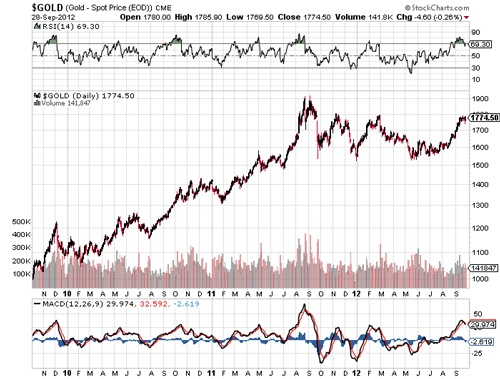
2. Gold prices will continue to rise.

When we look at the price of gold bullion today in inflation adjusted terms, it would need to be trading at $2,250 an ounce to be equal to its January 1980 price high of $850 an ounce.

But my public predictions about where gold prices are headed have been much higher. I’m expecting gold to trade at $3,000 before the bull market in the yellow metal is over.


Chart courtesy of www.StockCharts.com

Here’s an important fact I want you to be aware of:

After reaching an all-time record high of $1,921 an ounce on September 6, 2011, gold bullion prices have fallen back.

But we’ve been down this road many times before! In early 2003, the price of gold bullion fell 16%; in the summer of 2006 the price of gold fell 21%; from the spring to the fall of 2008 gold prices fell 28%; in the spring of 2009 gold prices fell 15%-- and each time the price of gold bullion recovered and moved higher by year’s end.

In fact, for 11 years running the price of gold bullion has closed each year higher in price than it started the year. The recent weakness in gold bullion prices (more like a correction in an ongoing bull market) is a tremendous opportunity for smart investors.

I’m a big bull on gold. Rising inflation, a debasing U.S. dollar, out-of-control government spending, and a currency printing press that never seems to stop will continue to push the price of gold higher.

But when I look at gold, if it moves from $1,700 or $1,800 to $3,000 an ounce over the next five years, as I expect it to, my gain will be close to 100%—as an investment, that’s not enough for me. I’m gunning for much bigger profits than that.

The big winners of the gold bull market will ultimately be the gold mining stocks. Look at this way. If a gold company’s cost to produce one ounce of gold is $900, at a price of $1,800, they are making a 100% profit. But, at price of $3,000, they are making a profit of 233%—and the stock market will reward the stock by multiples of 233%.

3. The euro is as done as the U.S. dollar.

I’m blessed to be able to visit Europe once or twice a year to check on the economies of various European countries. Let me tell you firsthand, things are much, much worse in Europe than people read in the mainstream media.

On October 27, 2011, the euro zone leaders said they would bail out Greece, with European banks taking a 50% haircut off the value of their loans to Greece. By February 20, 2012, the eurozone Finance ministers agreed to a second bailout for Greece.

Greece has technically defaulted on its debt. I believe Spain and Italy are not far behind.

Austerity measures are a difficult sell in Europe. On the same day Greece passed its most severe austerity measures yet, February 12, 2012, 100,000 Greek citizens took to the street in protest. A 5,000-man police army was not enough to stop the protestors from setting fires to buildings. In a nut shell, Athens burned as the latest Greek austerity bill was passed.

2012 will bring stronger citizen protests in Europe thanks to even more severe austerity measures that will be introduced this year.

Every morning, I wake up and ask this one question: when will Germany come to its senses and pull out of the euro? After all, Germany is the only real engine of the European Economic Community. Greece’s GDP…it’s less than 10% of Germany’s GDP.

The euro has declined steadily against the U.S. dollar. I actually envision a time when the richer European countries will tire of bailing out the poorer European countries (it’s actually happening right now), when each country will just go back to its own currency. Ultimately, the euro will die, and with it the economies of the weaker European countries: Greece, Spain and Italy.

4. Inflation will become a real problem in America.

According to the U.S. Bureau of Labor Statistics, the producer price index (“PPI”) is running at 4.1% per year.

While few are talking about it, inflation is a real problem in America. That’s what the rise in gold price has all been about: Gold is screaming: “Higher inflation ahead!”

Thanks to years of monetary policies that promoted artificially low interest rates and printing presses churning out dollars in overtime mode, hyperinflation and American sovereign debt issues will become the biggest obstacles for the United States for the remainder of this decade and well into the next decade.

After falling for 30-years, short-term interest rates are bottoming out. The long-term 10-year U.S. Treasury, it’s yielding a pathetic 2%-- a 50-year low. All cycles come to end. And I believe USA is near the end of a long-term down cycle in interest rates.

While it may difficult to see today, and as crazy as it may sound, the government will be forced to raise interest rates to fend off inflation—just like it did in the early 1980s..

Higher interest rates will also put the proverbial remaining nails in the coffin known as the U.S. housing market.

Now you see why I said at the very beginning of this article that it’s not for the faint of heart. Imagine our government, the economy, housing prices and the stock market all collapsing at the same time? But, for smart investors, there is more than just hope. As history has shown us, where there is fear, there is also profit.

5. The stock market will ultimately test its lows of March 2009,
bringing the Dow Jones down 46% from where it sits today.

Yes, this is my final core belief: The bear market rally in stocks will lose steam somewhere in the next few months and move straight down to test its March 2009 lows.

Phase One of a bear market brings stock prices down sharply. That’s what happened when the Dow Jones Industrial Average fell from 14,164 in October 2007 to 6,440 on March 9, 2009—a tumble of 54%.

Phase Two of a bear market is when the bear lures investors back into stocks. The bear gives investors and analysts the false sense that the economy is improving and it’s okay to own stocks again. The bear did a masterful job at convincing investors to own stocks again…and, presto, the Dow Jones got back to over 12,000. But the bear market is getting old and “long in the tooth” as they say. If I compare this bear market rally to the bear market rally of 1934 to 1937, we have a few months left before Phase Three of this bear market gets underway—ultimately bringing stock prices below their March 2009 lows.


Disclaimer: This is just a research piece and not an investment advice. All financial transactions carry a RISK.